
Orleans County Court Records After Arrest
The local path is arrest, booking, first court appearance, prosecutor review, and a court case that tracks the charge. Orleans County Jail handles the booking and custody side for local defendants. The Orleans County District Attorney handles prosecution after law enforcement makes the arrest, and the court record may not match the first booking note. A law enforcement arrest charge can be amended, reduced, dismissed, or replaced by a later filing. For felonies, a grand jury indictment can also change the case posture after the first court appearance.
The custody record and the court record answer different questions. Jail staff may confirm whether someone is held at Orleans County Jail, while Orleans County jail inmate records address current custody, bail payment, and release status. Booking photos and photo-release limits are separate from the charge record, so Orleans County jail mugshots belong to the booking-photo path. Court records after a jail arrest focus on the formal accusation, the court date, the disposition, and any later sealing limits.
The official court and records sources for Orleans County are split. New York WebCriminal is the statewide court search path for pending criminal cases with future appearances in selected courts. The Orleans County Clerk publishes forms for County Court record searches and criminal certificates of disposition. The County Court page from the New York courts system gives local court contacts for County Court matters in Albion.
Find Orleans County Court Records
For pending criminal court information, start with New York WebCriminal. The official courts description says WebCrims provides information on criminal cases with future appearance dates for selected New York State courts of criminal jurisdiction. That makes it most useful for upcoming court dates and active matters. It is not a full statewide criminal-history report, and it does not replace a court-certified disposition.
The WebCriminal portal screenshot is a matching official source for Orleans County court records after an arrest because it shows the court search paths used for pending criminal matters.
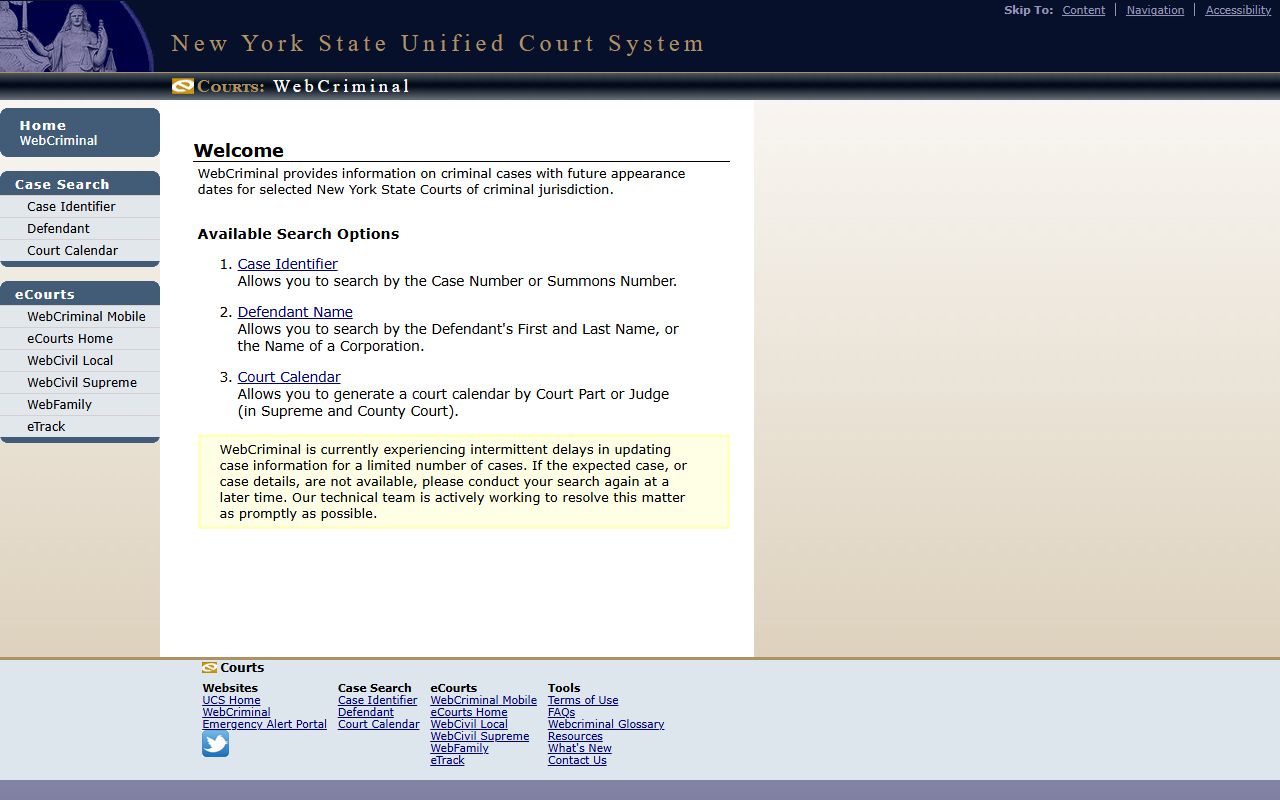
Use the WebCriminal result as a current-case pointer, then confirm certified records through the court or clerk when a disposition, certificate, or complete County Court search is required.
| Search Path | Type | When to Use It | Notes |
|---|---|---|---|
| Case Identifier | Portal tab | When the docket or case identifier is known | Best when a court paper already lists the case number. |
| Defendant | Portal tab | When searching by person name | Use careful spelling and compare birth or case details where shown. |
| Court Calendar | Portal tab | When checking scheduled appearances | Most useful for pending cases with future court dates. |
Orleans County Court Request Form
The Orleans County Clerk publishes a County Court Record Search Request Form for local County Court records. The form states that it is limited to Orleans County Court and is not a statewide search. It also limits each search to a two-year date range. A search costs $5, and name variations for the same date range are treated as separate searches. The form includes an AKA field, so aliases can be included in the returned result when the request is set up correctly.
The Orleans County Clerk forms page links the court-record search request and the criminal certificate of disposition request.
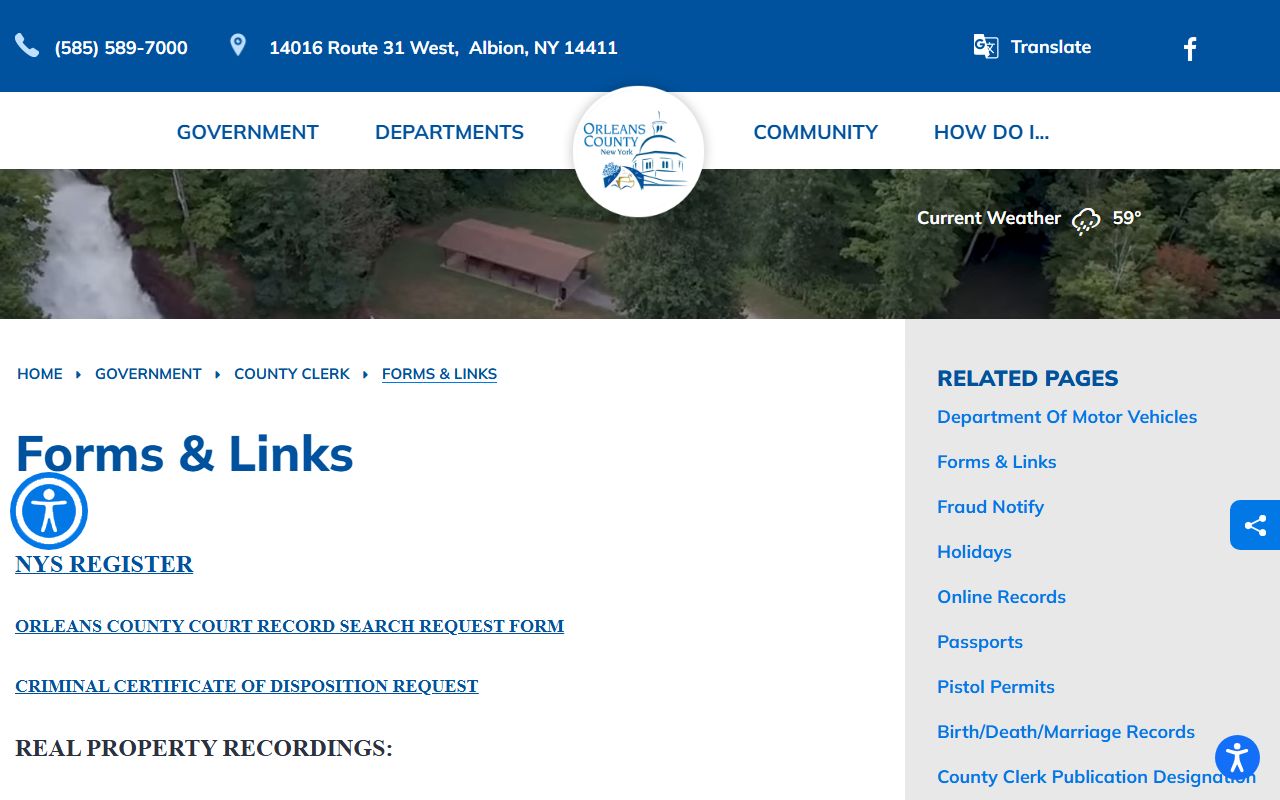
The forms path matters when WebCriminal does not show the case, when an older County Court record is needed, or when a court-certified disposition is more useful than a pending-case screen.
| Field | Type | Required | Orleans County Notes |
|---|---|---|---|
| Defendant name | Text | Implied | Last name, first name, and middle initial help identify the record. |
| AKA | Text | Optional | Aliases can be included in the result, but separate name variations can require separate searches. |
| Date range | Date field | Required | Each search is limited to a two-year period. |
| Requestor details | Contact fields | Implied | Name, agency, address, phone, fax, and email fields appear on the form. |
| Payment | Checkbox or card fields | Required for paid search | The form lists cash, check or money order to the clerk, and credit card, with a $1 card service charge. |
Note: Verify the safest current submission method with the clerk before emailing any form that contains payment-card data.
Charges Filed After Arrest
A jail arrest starts with law enforcement action, but the court charge is built from an accusatory instrument. In plain terms, that is the paper that tells the court what offense is alleged and why the case should proceed. Orleans County cases can involve local criminal court filings for misdemeanors and violations, County Court handling for serious matters, and later felony filings where the charge moves by indictment or superior-court process. The District Attorney may file, amend, reduce, dismiss, or present charges after reviewing the arrest materials.
| Document | Common Use | Who Drives It | What It Means |
|---|---|---|---|
| Complaint | Initial local criminal case | Law enforcement or prosecutor | Starts the accusation after an arrest and booking. |
| Information | Misdemeanor or local criminal court matter | Prosecutor or court process | Can support prosecution when the required sworn facts are in place. |
| Indictment | Felony prosecution | Grand jury | Supersedes or advances the felony charge in a higher court posture. |
Orleans County Charge Status
Charge status is not static. A person can be booked on one offense and later face a different court charge after prosecutor review. A pending charge means the case has not reached final disposition. A reduced charge may reflect plea talks, evidence review, or a court ruling. A dismissal means the charge ended without a conviction. A disposition is the final result, such as conviction, dismissal, acquittal, or another legal termination.
| Status | Plain Meaning | Why It Matters |
|---|---|---|
| Pending | The charge is still open. | Future court dates may appear in WebCriminal when the court is covered. |
| Amended | The charge was changed after filing. | The court record can differ from the first jail booking note. |
| Reduced | The charge level or offense was lowered. | A felony accusation may resolve as a lesser offense. |
| Dismissed | The charge ended without conviction. | Sealing may be available when the case terminates in favor of the accused. |
| Disposition | The final case outcome. | Employers, licensing bodies, and courts often ask for certified dispositions, not booking records. |
Orleans County Court Contacts
The New York courts Orleans County Court page identifies County Court Judge Hon. Sanford A. Church and lists Supreme and County Court Chief Clerk Kristin E. Nicholson. The court page gives the chief clerk phone as 585-283-6657 and email as knichols@nycourts.gov. The same court source also lists local coordinator contacts, including IDV Court Coordinator Amy Klein and Treatment Court Coordinator James Messe.
The official court page is useful because it separates court administration from jail custody and prosecution.
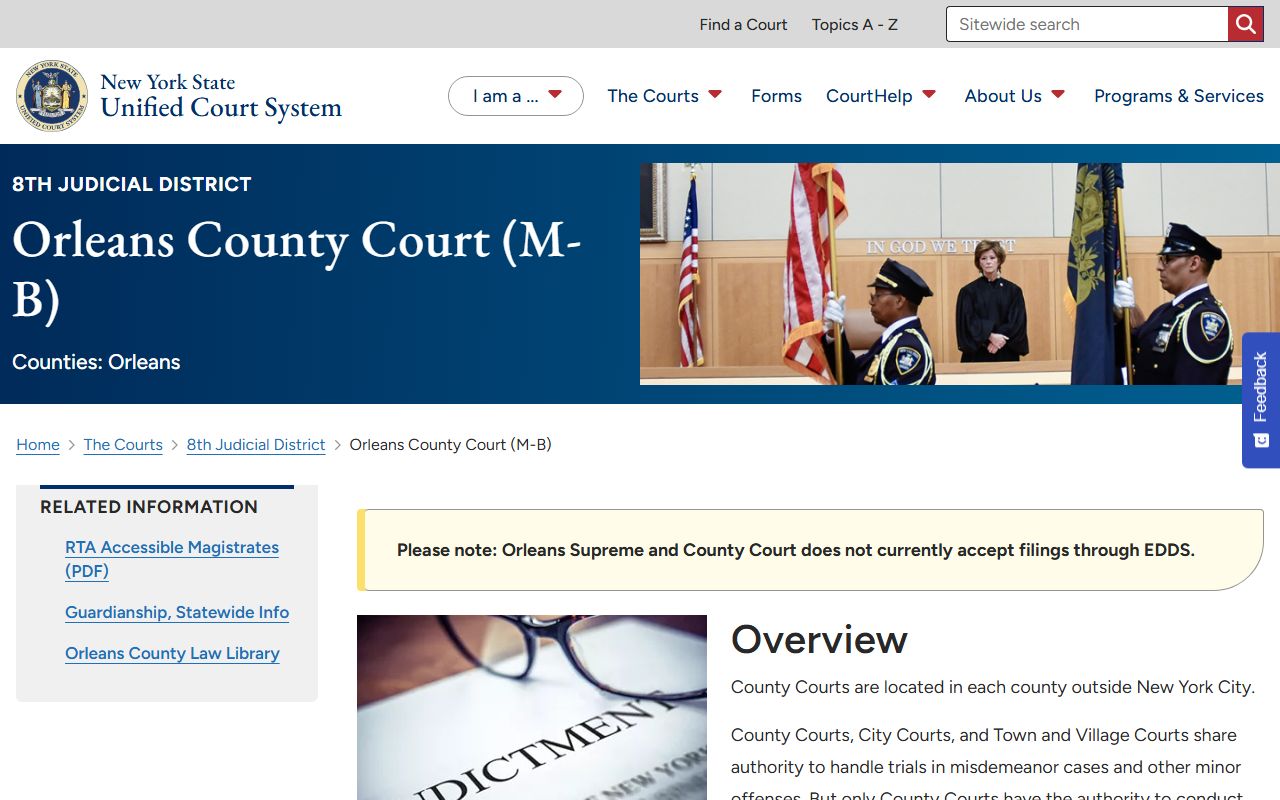
Use court contacts for court scheduling, clerk routing, and court-record questions. Use the jail for custody or bail-payment confirmation, and use the District Attorney for prosecution office context rather than case advice.
District Attorney Charge Role
The Orleans County District Attorney prosecutes criminal cases after arrest and booking. The official District Attorney page names Hon. Susan M. Howard as District Attorney and lists the office at 13925 State Route 31, Suite 300, Albion, NY 14411. The office phone is (585) 590-4130, fax is (585) 590-4129, and email is da@orleanscountyny.gov. Staff listed in the research include 1st Assistant District Attorney Daniel J. Punch, Assistant District Attorneys John C. Gavenda and Earl A. Voss, Administrative Assistant Richard M. Ferris, and Discovery Coordinator Jennifer M. Leverenz.
The official DA page is the local source for the prosecutor office that reviews charges after an Orleans County arrest.
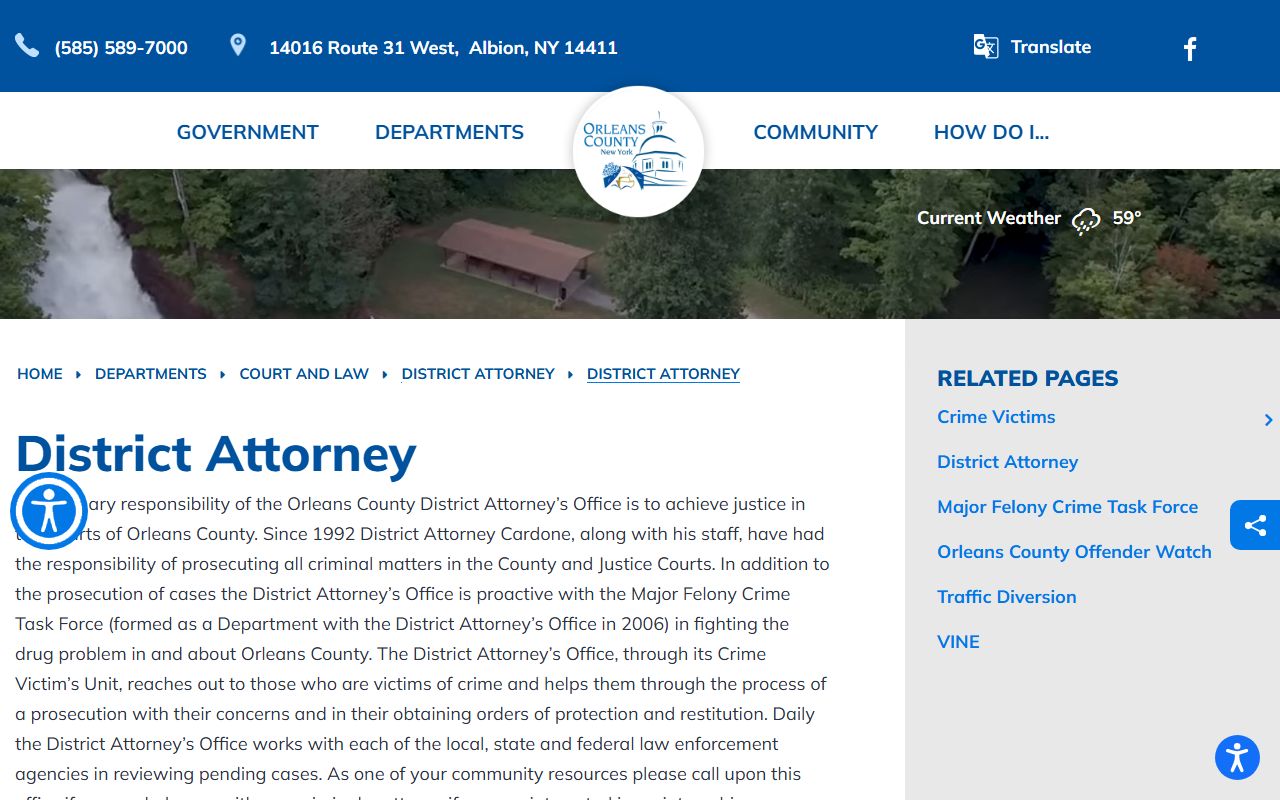
A prosecutor office page does not prove the status of a specific charge. It identifies the agency that files and manages the criminal case after booking.
Bail After Jail Arrest
Bail and release are part of the court pathway because the court, not the jail, sets the securing order. New York Criminal Procedure Law section 500.10 defines terms such as recognizance, bail, principal, and securing order. Article 530 governs when a court may order recognizance, non-monetary conditions, bail, or remand. Orleans County Jail accepts bail payment when bail has been set and no other hold blocks release.
| Release Term | How It Works in Orleans County |
|---|---|
| Recognizance | The court releases the person on a promise to appear. |
| Non-monetary conditions | The court may set supervision or other conditions instead of money bail. |
| Cash bail | Orleans County Jail accepts exact cash when bail is payable at the jail. |
| Credit-card bail | The payer's name must be on the card, and the transaction fee is nonrefundable. |
| Remote credit-card bail | AllPaid may be used, with release after facility confirmation of the completed transaction. |
| Hold or remand | ICE, federal, parole, other-county, state-ready, warrant, or court holds can prevent release. |
Warrants Before Court Records
A warrant can be the event that leads to the Orleans County jail arrest. The Sheriff's Office publishes an Active Warrants page for wanted persons, but the research found no searchable warrant form fields. The page says status can change at any time, that the list is updated as often as possible, and that information can be given anonymously to dispatch at 585-589-5527. It also warns the public not to approach or restrain a wanted person.
A bench warrant can arise from a missed court date or a failure to comply with a court order. A search warrant is different because it authorizes a search of a place or item, not an arrest by itself. A federal warrant, immigration detainer, parole warrant, or outside-county hold may not appear on the Orleans County Sheriff's warrant page, even if it affects release from the local jail.
Charges vs Convictions
An arrest and a charge are not proof of guilt. A charge is the formal accusation that lets a criminal case move forward. A conviction is a final guilt finding or plea. The difference matters when reading Orleans County court records after a jail arrest because an online court entry, warrant list, or requested record may show only a pending accusation. Treat the disposition as the key field when trying to learn how the case ended.
| Point | Charge | Conviction |
|---|---|---|
| Stage | Accusation after arrest or filing | Final guilt finding or guilty plea |
| Proof level | Can begin from probable cause and court filings | Requires plea or proof beyond a reasonable doubt |
| Record clue | Often appears as pending, amended, reduced, or dismissed | Appears in the disposition or certificate of disposition |
| Use limit | Should not be treated as guilt | Still must be read with date, offense, and sealing status |
Sealed Orleans County Arrest Records
New York uses sealing more often than full expungement for criminal case access limits. Criminal Procedure Law section 160.50 addresses sealing after a criminal action terminates in favor of the accused. Sealing can restrict public access to arrest and court records after dismissal or another favorable termination. It does not mean every copy on the internet disappears, and it does not give a private person authority to alter court records without the proper court or agency action.
| Point | Sealed | Expunged |
|---|---|---|
| Basic effect | Public access is restricted by law or court order. | The record is destroyed or treated as though it did not exist where allowed. |
| New York context | CPL 160.50 is a key favorable-termination sealing law. | Full expungement is not the ordinary remedy for most New York arrest records. |
| Agency access | Some justice agencies may retain limited access. | Access depends on the specific statute or order. |
| Practical next step | Ask the court or counsel about the sealing order and certified disposition. | Do not assume a record is expunged unless an order or statute says so. |
Important: Court and jail information must not be used for employment, credit, housing, insurance, or another FCRA-regulated decision.
Restricted Court Records After Arrest
New York FOIL gives access to agency records, but access is subject to exemptions and court restrictions. Public Officers Law section 87 allows withholding where disclosure would invade privacy, interfere with law enforcement, create safety risks, or reveal records made confidential by law. Public Officers Law section 89 sets FOIL procedure and appeal rules. Juvenile matters, sealed cases, victim information, protected witness information, and active investigative records may be restricted even when an arrest did occur.
For Orleans County, match the request to the record holder. Use WebCriminal for pending court dates, the County Clerk's County Court request form for local County Court searches, the jail for current physical custody, and county FOIL for sheriff or jail records that are not posted online. VINELink can help with custody notifications, but it is not the court record and should not be treated as a certified disposition.